

Does Your Drafty Door Need a Repair or Replacement in Albany NY?
The situations described here are composites drawn from the types of jobs and decisions we encounter regularly. Names and specific figures are illustrative.
The lead came the morning after the first real frost of October. A retired couple in a 1950s brick ranch in Loudonville said the front hall felt like a walk-in cooler, and the back room with the patio slider was worse. They already had a written quote from a door-replacement company to swap both doors before Thanksgiving. Before signing it, they wanted someone to look at whether this was a job for drafty door repair in Albany, NY or whether the doors really were finished. That is a fair thing to ask, and in my experience the answer is often different for each door in the same house.
Why the cold shows up in the middle of October
Nothing changed with those doors overnight. What changed was the temperature on the other side of them. Albany’s first fall freeze has landed between October 10 and November 2 in each of the last five years, according to the National Weather Service growing-season records for the city. In September a worn seal leaks air that is roughly room temperature, so nobody notices. The first night in the twenties, the same gap pulls in air that you feel on your ankles from across the room.
That timing is why so many Capital Region homeowners meet a replacement salesperson in October. The door feels broken because it suddenly feels cold. Most of the time the door slab itself is fine and the parts that wear out are the ones designed to wear out: the rubber, the vinyl, and the adjustment screws.
The dollar bill, the flashlight, and the foam tape test
On the front door I started the way I always do. I closed a dollar bill in the door at six or seven points around the frame and pulled. Where the seal is working, the bill drags. On this door it slid out freely along the whole latch side and across the top corner. After that I had the homeowner stand outside with a flashlight while I looked from the hallway with the lights off. Light came through at the top latch corner and in a thin line under the bottom.
Then I found the foam tape. Sometime the previous winter, one of them had bought a roll of adhesive foam weatherstrip and stuck it to the door stop, right over the old factory seal. This is the most common misconception I run into on drafty doors: if the seal is leaking, add more seal. On a steel entry door the original weatherstrip is a compression bulb pressed into a slot, called a kerf, in the jamb. Foam tape on top of it does two things. It pushes the door away from the bulb so the bulb no longer touches, and it makes the door harder to latch, so people start slamming it. The foam itself had already torn at the latch where the door rubs every day.
Here is how the walk-around on the front door laid out once everything was pulled back.
| Spot on the front door | What it looked like | What fixed it |
|---|---|---|
| Latch-side jamb seal | Bulb flattened and split, foam tape stuck over it | Removed tape, new kerf-in compression seal on all three sides |
| Bottom of the door | Door bottom sweep torn, fins missing in the middle | New slide-in door bottom sized to the door |
| Threshold | Adjustable cap screwed all the way down | Raised the cap until the new sweep just dragged |
| Strike plate | Door latched without pressing into the seal | Adjusted the strike so the door pulls snug when latched |
| Outside trim | Caulk cracked where the brick molding meets the brick | Cut out old caulk, backer rod and new exterior sealant |
None of that list involves the door itself. The steel skin had no rust at the bottom edge, the core had not separated, the jamb was solid when I pushed an awl into it, and the hinges were tight. When the slab and frame are in that shape, the draft is a seal problem, and seals are a few hours of work.
Why a replacement was not needed
The homeowners asked a reasonable question at this point: if the quote was for a new door, would a new door not also fix the draft? It would. A new prehung door comes with new seals, a new sweep, and a new threshold. The question is what else you are buying. On this house the replacement price covered tearing out a frame that was not failing, new interior trim, and new paint on the inside casing, to get the same three seal parts that could be replaced on the existing door.
Building America guidance from the Pacific Northwest National Laboratory describes the correct seal as one that presses tightly into the jamb when the door is closed and still lets the door close fully. New York’s Homes and Community Renewal weatherization tips say the same in plainer terms: thick enough to press tight, not so thick the door is hard to close. That balance is the whole job. A replacement door gets there because it is new. An existing door gets there when someone takes the time to match the seal profile and set the strike and threshold so the door closes into it.
Why the back slider needed to be replaced
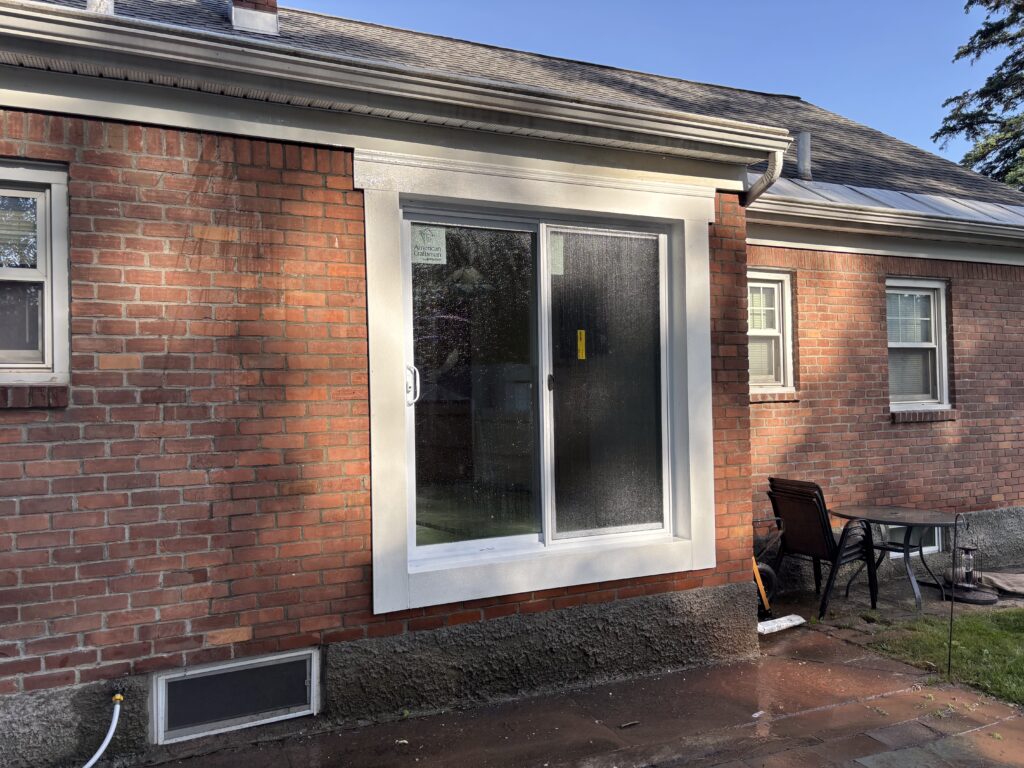
The patio slider in the back room was original to an addition from the 1970s. Aluminum frame, worn pile weatherstrip on the sliding panel, and a cold metal frame that sweated on winter mornings, according to the homeowners. On paper, new pile weatherstrip and a cleaned-up track might have quieted the draft. Then I checked the wood subsill under the aluminum track. A screwdriver went in about half an inch on the outside corner. Years of condensation running off the frame had soaked it.
This is where spending money on repair stops making sense. You can reseal a slider sitting on rotting wood, but you are paying for a seal that will be pulled out of shape as the sill keeps softening, and the aluminum frame will keep conducting cold into the room either way. Repair on that door meant paying twice.
Here is how the two doors lined up when we sat down at the kitchen table.
| Question | Steel front door | Aluminum patio slider |
|---|---|---|
| Door or panel sound? | Yes, no rust or delamination | Frame worn, sweats in winter |
| Frame and sill solid? | Yes | No, subsill soft at the outside corner |
| What we did | New seals, sweep, threshold and strike adjustment, exterior caulk | Replaced the unit, new subsill, new exterior trim |
| Rough cost on this job | About $300 in labor and parts | Low four figures, unit included |

If the replacement company’s quote had been for the slider alone, I would have told them to sign it. The quote was not wrong about the back door. It was wrong about the front one. You can see more door and window work like the slider on our previous projects page.
What happened after the seals went in
The front door took a little under three hours, most of it spent removing foam tape adhesive from the stop and fitting the new seal into the kerf without stretching it. Stretched compression seal pulls back from the corners within a few weeks, which is where the top corner draft starts again. When the door was done, the dollar bill dragged at every point, and the flashlight test showed nothing.
There was one tradeoff the homeowners did not love. For the first week the door needed a firmer push to latch, because a fresh compression seal is stiffer than one that has been flattened for fifteen years. I told them to expect it and to leave the strike alone. By the second week it had settled. If they had backed the strike off to make it easier, the draft would have come back at the latch.
The slider replacement went in the following week. With the new subsill and a fresh trim surround on the brick, the back room stopped being the place nobody sat after dinner. The homeowners spent less than half of the original two-door quote overall.
What people usually ask me at this point
The first question is almost always whether this will lower the heating bill. Honestly, by a modest amount. The Maryland Energy Administration’s weatherstripping guidance points out that door and window drafts are a small share of a home’s total heat loss, and that the bigger benefit is comfort. A sealed front door makes the hallway livable. It does not replace attic insulation or air sealing at the top of the house. Income-eligible New York households can get a no-cost home energy assessment through NYSERDA’s EmPower+ program, which looks at the whole house rather than one door.
The second question is whether it is too late in the year to do this. It is not. New York’s weatherization tips say weatherstripping should go on clean, dry surfaces at temperatures above 20 degrees, and in the Capital Region most of October and November clears that easily on a dry afternoon. The adhesive caulk at the exterior trim is the part that cares most about temperature, so that is the piece to do on the warmest day available.
The third question is about the foam tape. People want to know if they did damage. Usually not. The adhesive comes off with patience, and the stop underneath is fine. The lesson is that foam tape is meant for gaps where nothing else is sealing, not as a second layer over a seal that already has a slot built for it.
And the last one, usually asked quietly, is how to tell when a door really is done. On an exterior door, the signs I look for are rust coming through the bottom of a steel skin, a fiberglass or steel skin separating from the core, a wood door with a split or soft bottom rail, or a jamb and sill that are soft when you probe them. If none of those are present, the door can usually be sealed. If the frame is rotting, the seal will not hold no matter how good it is. The June post on why front doors stick in Albany summers covers the opposite season, when the same doors swell instead of leak.
What this house changed about how I quote doors
I used to treat the two doors in a house as one job. This house was a reminder that each opening gets its own answer. One door had a failing seal and nothing else. The other had a failing seal sitting on a failing frame. The first was a repair. The second was a replacement. A single quote covering both would have been wrong in one direction or the other.
If you have a cold door this month, the order that tends to work is to test the seal, look at the sweep and threshold, check that the latch actually pulls the door into the seal, and only then look hard at the door and frame. That is the whole substance of drafty door repair in Albany, NY, and it is worth doing before a replacement quote gets signed. The rest of our fall work, from gutters to caulking, is on the services page, and the broader seasonal list is in our fall home repair checklist for Albany homes.
If you would like someone to look at a drafty door in the Capital Region, you can reach out here.
Sources
- Growing Seasons, Albany, New York (first and last freeze dates), National Weather Service Albany
- Weatherization Tips: Tips for Weatherstripping Windows and Doors, New York State Homes and Community Renewal
- Add Weatherstrip to Windows and Doors, Building America Solution Center, Pacific Northwest National Laboratory
- Air Sealing Doors Adjacent to Unconditioned Space, Building America Solution Center, Pacific Northwest National Laboratory
- Weatherstripping, Maryland Energy Administration
- EmPower+ Program, New York State Energy Research and Development Authority (NYSERDA)